Global Positioning Systems (GPS)

Saturday, May 30, 2009

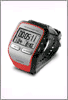
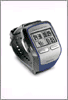
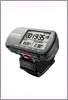
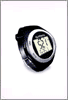
Garmin's New Forerunner Is King of Wrist-Mounted Trainers

Garmin's newest wrist-top fitness watch is a 50-megaton blast forward that combines the best of the company's past two Forerunner models — the 305 and 405 — but easily laps both on almost all counts. Like its predecessors, the 310XT uses GPS to track your runs and rides, but it adds so much more to the equation that it feels like a breakthrough device rather than an upgrade.

garmin forerunner 310 xt

Triathletes in particular will love this watch — it's certainly the best triathlon timekeeper we've yet tested. Not only does it sync up with your ANT+ power meter to display watts as you roll along on the bike, but the auto-multisport mode also lets you switch from one sport to the next by hitting the lap button, and it times your transitions to boot. And this wrist mounted wonder isn't some aqua-phobic wussy either: The new waterproof body can stand up to steady dunking, you can also take it swimming, kayaking, surfing and rowing without fear of turning it into a brick.

Garmin has shrunk the guts of this baby enough that it looks almost like a standard, if very odd, watch. Metrosexuals might give it a pass, but soul-sucking hipsters could probably get away with wearing it in public.

Setup is dead simple. When you first fire it up the watch walks you though a series of questions, and inputs all of your basic data. We did have a bit of trouble getting it to recognize our heart-rate strap initially, but resolved that within a few minutes without having to make a call to tech support or engage in an extraordinary amount of cursing.

In addition to the heart rate monitors and power meters, it will also sync up with Garmin cadence sensors to track your bike crank's RPMs, and to footpods if you want to measure your running cadence on a treadmill or the trail. If you fancy racing in both on road and Xterra events, you'll be pleased with the multiple presets for different bikes, allowing you to have one weight setup for your mountain bike and another for your road rig. Overall the interface is easy to use and intuitive, although it takes a little more tinkering and RTFMing than other Forerunner models.

When it comes to performance tracking, the new 310XT is so strong we expected it to fail a drug test. It tracks just about every fraction of workout data you'll need to know, gives you instant feedback and keeps a history file on the watch that can also upload to Garmin Connect (more on that in a bit). Power, calories, heart rate, speed, distance, elevation: You name it, they're all there. It can also help make your workouts more effective. You can easily set up custom interval workouts right in the watch. A vibrating alarm lets you know when you've gone certain distances or drop out of heart rate or speed zones. The tactile feedback is fantastic, not only because it keeps you from having to glance at the watch, but also because it means you can wear headphones and still stay informed, or receive alerts on a group run without bugging your pals.

But when you do want to peep, you can customize the display with up to four data fields for each screen, and swap between multiple screen presets so you can keep your top tier data like speed, heart rate, time and distance on one screen. Then swap to another for secondary metrics like elevation, grade and calories burned.

Because each sport supports up for four screens, this means you can keep track of at least 16 metrics for each sport — making you the biggest nerd in the race if not the fastest competitor. New features like in-watch heart rate graphing, power tracking, and nautical speed and distance tracking are also impressive.

The watch can be charged up either with a wall plug, or by connecting it to your computer's USB port. A progressive meter indicates the amount of charge when the watch is turned off — a nice feature that lets you know if you've got enough juice to hit the road for a few hours or not. Garmin claims the watch will take you through a heart-stopping 20 hours of training on a single charge. We were too pooped to work out that long, but we did manage to squeak in more than six hours of activity with a lot of button pushing and still left the battery 64 percent full.

One thing we couldn't test was what happens when you get home. This Forerunner is designed to wirelessly sync your workouts with the Garmin Connect website. However, we couldn't test data uploading as the Garmin Connect website isn't set up to receive data from 310XT model Forerunners yet (unless you're behind the Garmin corporate firewall, that is). We'll check back when it's up and running, and update this review as necessary to reflect that.

This Forerunner is the king of training tools, and among the best heart-rate, speed and distance tracking wrist tops we've seen in the past several years. Having said that, for elite and pro level athletes, it doesn't offer the kind of complex heart rate monitoring and stride feedback available on the Polar RS800CX, which we recently reviewed. But for most athletes simply seeking a personal best, the Forerunner 310XT will take you there in stride.

Labels: , , , ,

Sunday, October 05, 2008

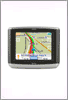
Garmin GPSMAP 640

GPSMAP 640 is the latest dual purpose GPS navigation system from Garmin for both the land and the sea.

GPSMAP 640 is portable and rugged, and has a waterproof (IPX7) 5.2″ WVGA touchscreen display with 800×480 pixels resolution. It comes preloaded with maps of North America and worldwide shaded relief mapping in addition to detailed U.S. coastal BlueChartg2 charts.

GPSMAP 640 is smart enough to automatically start up in marine mode when placed in its included marine mount. Also with the optional BlueChart g2 Vision technology, the GPSMAP 640 can provide a 3-D "mariner's eye view," for a navigation perspective above the waterline, and a "fish eye view" for an underwater 3D bathymetric contour perspective.

Mariners will also benefit from the auto guidance technology the g2 Vision data card enables that suggests the best navigational route. In addition, photo references give detail aerial views of points of interest (POI) such as ports, marinas, waterways and landmarks.

GPSMAP 640 also has support for XM WX Satellite Weather with the GXM 40 antenna which can display the information directly on the screen. With GXM 40 you'll have access to more than 20 different types of weather attributes, nearly 200 channels of commercial-free music, news, sports talk and entertainment with XM Satellite Radio, and XM NavTraffic to avoid traffic.

GPSMAP 640 will go for $1200 when it first comes out.


Saturday, August 30, 2008

Using Google Maps with your Garmin GPS Device

Did you know that you can send Google Map information directly to your Garmin GPS device? In this video, you will see how.

Saturday, August 16, 2008

Lenovo GPS phone

Who knew Lenovo did GPS phones? This one we have is apparently Lenovo P990 and is available in Asia. Now you know that Lenovo doesn't only make great business-class computers, they are also in the handset business with the Lenovo P990 being the latest handset to be released in Asia.

Lenovo P990 supports GSM900 and GSM1800 networks, has a 3″ screen with 240×320 resolution, utilizes a 3 core CPU and its memory can be expanded with microSD cards. In addition there's the SiRF Star III GPS receiver, 2MP digital camera and a powerful 1450mAh battery. This is a GPS-enabled slider phone, and it comes with the following specifications:

* GSM 900/1800
* 3" display
* SiRFStar III GPS chipset
* 240 x 320 resolution
* 3-core CPU
* microSD memory card slot
* 2 megapixel camera

We still know very little about this phone but if you're from China and reading this maybe you can share some details with us.

Saturday, July 19, 2008

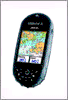
New Garmin Oregon Series


Just 4 months after Colorados, Garmin announces new handheld GPS-s OREGON.

The new boxes are a little smaller and lighter than the Colorado series, with a rugged, waterproof casing, 3-inch 240 X 400 sunlight readable touchscreens, customizable user profiles, and the ability to transfer waypoints, tracks, routes, and geocaches between units. We're assuming pricing will change when these things get real, but for now the 200 is listed at $420 and the 400C is listed at $558. It's not exactly clear what the specific differences between the line is, except that the 400 will come in several flavors, with the 400C variant sporting BlueChart g2 marine maps for the coastal US and Bahamas. Hopefully we'll get some more details soon, as these bad boys seem ready to go.

Monday, July 07, 2008

Garmin Nuvifone

Garmin's recently (and abruptly) announced handset obviously marks the firm's first solo foray into the cellphone arena, and according to Cliff Pemble, the firm's president and COO, it's the "breakthrough product that cellphone and GPS users around the world have been longing for." That being said, the unit will feature a 3.5-inch touchscreen with a trio of primary icons -- Call, Search and View Map -- along with an internet browser, HSDPA support and preloaded maps of North America and / or Eastern and Western Europe. Furthermore, it houses "millions" of POIs, doles out turn-by-turn, voice-prompted directions and becomes Garmin's first device to include Google's local search capability. As for pricing and availability? We're looking at a Q3 2008 release, but we'll have to wait things out before finding out a price and who exactly will be carrying it.

In case that wasn't enough, here's an overview of the rest of the features:

* "Where am I?" - spits out precise longitude / latitude coordinates at a moment's notice
* Helps drivers remember where they parked by marking the position in which it was last removed from the vehicle mount
* Garmin Online - an online service offering constantly updated information such as real-time traffic, fuel prices, stock prices, sports scores, news reports, local events and weather forecasts
* Built-in camera (megapixels currently unknown; captures video as well) that automatically tags photos with exact longitude / latitude. This allows the user to navigate back to the location or email the image to a recipient who can navigate directly to its location.
* Provides direct access to millions of geo-located landmark and sightseeing photographs available through Google's Panaramio picture sharing site
* Integrated media player to handle MP3, MPEG4 and AAC files
* Just in case you missed it: Q3 2008 release; price and "sales partners" will be announced "in the future"

Labels: ,

Friday, March 28, 2008

Google's new technology could enable location-finding services on cell phones that lack GPS.

As more mobile phones tap into the Internet, people increasingly turn to
them for location-centric services like getting directions and finding
nearby restaurants. While Global Positioning System (GPS) technology
provides excellent accuracy, only a fraction of phones have this
capability. What's more, GPS coverage is spotty in dense urban
environments, and in-phone receivers can be slow and drain a phone's
battery.

To sidestep this problem, last week Google added a new feature, called
My Location, to its Web-based mapping service. My Location collects
information from the nearest cell-phone tower to estimate a person's
location within a distance of about 1,000 meters. This resolution is
obviously not sufficient for driving directions, but it can be fine for
searching for a restaurant or a store. "A common use of Google Maps is
to search nearby," says Steve Lee, product manager for Google Maps, who
likened the approach to searching for something within an urban zip
code, but without knowing that code. "In a new city, you might not know
the zip code, or even if you know it, it takes time to enter it and then
to zoom in and pan around the map."

Many phones support software that is able to read the unique
identification of a cell-phone tower and the coverage area that
surrounds it is usually split into three regions. Lee explains that My
Location uses such software to learn which tower is serving the
phone--and which coverage area the cell phone is operating in. Google
also uses data from cell phones in the area that do have GPS to help
estimate the locations of the devices without it. In this way, Google
adds geographic information to the cell-phone tower's identifiers that
the company stores in a database.
Another approach is used by a startup called Plazes. This Swiss
location-tracking service has, over the past few years, established a
relatively small database of Wi-Fi hot spots around the world, manually
geotagged by Plazes users. Now, in a relatively large city, it's
possible to log on to Plazes using a Wi-Fi connection, and have the
software guess where you are because previous users have logged the
Wi-Fi hot spots' location, which can be an address or a business name.
In addition, researchers at Intel and the University of Washington
developed research software that uses a combination of Wi-Fi and
cell-phone tower radios to pinpoint a person's device. The now-complete
project, called Place Lab, takes advantage of any radio a person is
using, whether it's Wi-Fi on her handheld or laptop, or a cellular
signal from her phone, to triangulate location.

Google expects that over time, My Location's accuracy will improve. As
the database grows, says Lee, the service will become more accurate. It
will never be as accurate as GPS, but he expects that it could
eventually find a person within a couple hundred meters. And even at
that level of accuracy, there's still a lot of searching that Google can
do. "Search is really important," he says. "This product is searching
based on a map, but there are other types of local searching and
advertising and other products that can be made relevant" with the
technology, Lee says.

A few years ago, the Federal Communication Commission required
cell-phone companies to find a way to locate people making 911 calls so
that rescue workers could find them. The approach that most cellular
providers take is to use triangulation, which works if a person's phone
is visible to two or more cell-phone towers. But while a cellular
carrier can use information from any of its towers, Google and other
companies can't. The software available to them on a cell phone only has
access to the tower that the phone is using at any given time, not to
any neighboring towers.